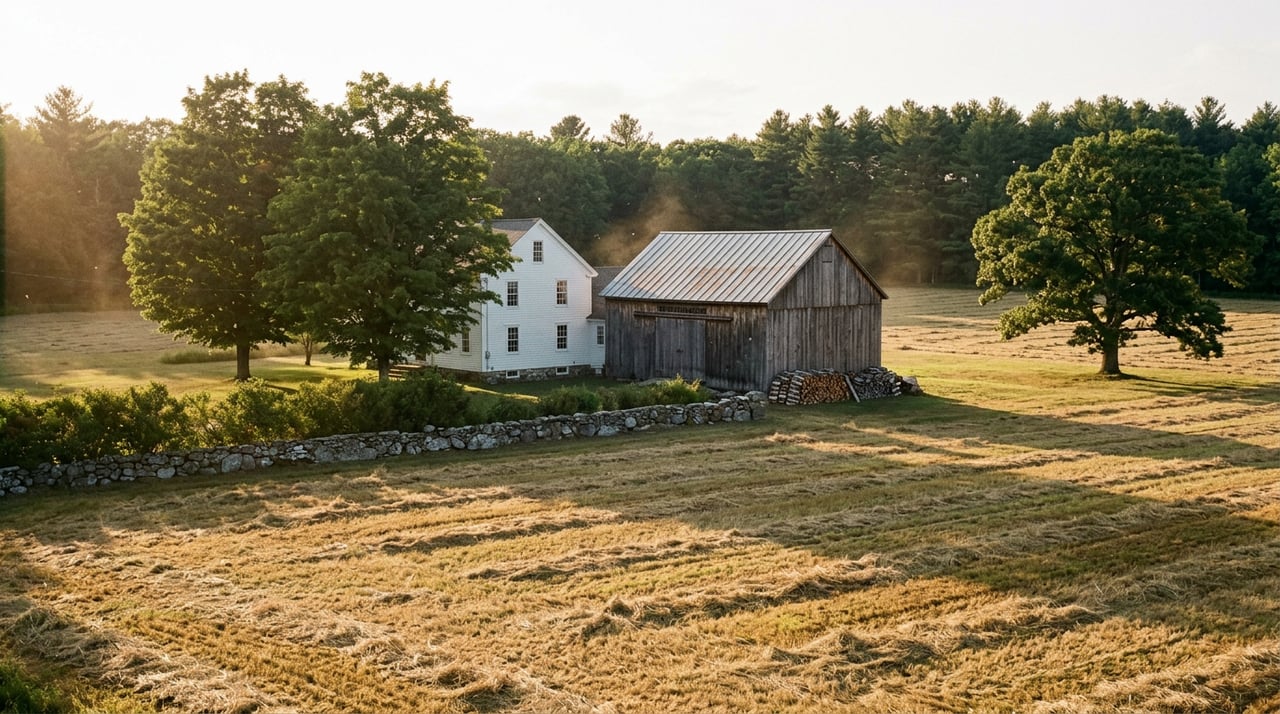
In Ancram and Gallatin, the Real Price of Land Is What You're Still Allowed to Do With It
Ask why one hayfield in Ancram sells for $12,000 an acre and a field two miles away sells for four times that, and most buyers reach for the obvious answers: soil quality, road frontage, a pond, distance from Route 82. Those things matter at the margins. They do not explain why the largest unrestricted farm left in the county, a 2,150-acre assemblage in the Ancramdale hamlet called Mill Farm, is asking close to $42,000 an acre while ordinary enrolled farmland nearby trades for $10,000 to $18,000.
The gap isn't quality. It's paperwork, specifically two records almost nobody reads before falling for a listing photo: the agricultural assessment on file with the town assessor, and the conservation easement recorded, or not recorded, against the deed. Both documents were written to protect farmland. Both also quietly set what a buyer will pay for it, and what a buyer inherits the moment the sale closes.
Mill Farm's own history explains the mechanism better than any market report could. Daniel Slott, a former Bear Stearns banker, bought the first 160 acres in 1982 for $250,000. Over the following 43 years and 29 separate transactions, he added neighboring parcels at prices ranging from $250 to $20,000 an acre, buying during the decades when Columbia County's dairy industry was contracting and land was cheap because almost nobody wanted it. He now holds 2,150 contiguous acres, and the farm is described in its own listing as surrounded on almost every side by thousands of acres of adjacent protected conservation land, making it one of the only working farms of that size left within two hours of New York City.
That last detail is the entire story. The land around Mill Farm isn't merely scenic. It's off the market permanently, already committed to conservation easements that forbid future subdivision or development no matter who owns it next. Mill Farm itself carries no such easement. It is one of a shrinking handful of large, unrestricted parcels remaining in the towns, and its asking price reflects exactly that scarcity, not superior dirt.
2016 | 2026 | |
|---|---|---|
Typical enrolled farmland, Ancram/Gallatin/Hillsdale | $5,000–$8,000/acre | $10,000–$18,000/acre |
Mill Farm, unrestricted 2,150-acre assemblage in Ancramdale | not yet offered | roughly $42,000/acre asking |
Every acre that Columbia Land Conservancy adds to its protected map makes the remaining unrestricted acreage rarer, and rarer land costs more. The easement program and the premium price are the same trend viewed from two sides.
An agricultural assessment lowers a landowner's property tax bill by valuing farmland at its agricultural production value rather than its market value. It's a real benefit, and it's why so many parcels advertised as "gentleman's farms" or "hobby farms" in Ancram and Gallatin carry taxes that look surprisingly low for the acreage.
The condition attached to that benefit is where buyers get caught. If land that received an agricultural assessment is converted to a nonagricultural use within five years of last receiving it, or within eight years if the parcel sits outside a state-certified agricultural district, New York requires the owner to pay back the taxes that were forgone. The assessor decides, case by case, whether an act like grading a new driveway, filing a subdivision map, or breaking ground on a guest house counts as conversion.
The detail that catches people off guard at closing is that this liability travels with the land, not with the person who originally filed for the exemption. A buyer who closes on a parcel enrolled by the previous owner inherits whatever time remains on that clock. Anyone planning a pool house, a horse barn addition, or a second driveway on recently enrolled acreage needs to ask the town assessor how many years remain before signing a contract, not after moving in.
One thing has changed in the buyer's favor this year. New York eliminated the option for sellers to skip the required property condition disclosure form by paying a flat fee, which means more sellers in Ancram and Gallatin are now filling out the actual state disclosure form rather than opting out of it. That form specifically asks whether anyone besides the owner holds a lease, easement, or other right to use part of the property, which is exactly where a conservation easement or an agricultural district designation would surface. It helps, but New York still follows a buyer-beware standard on anything a seller genuinely didn't know, so the form is a starting point, not a substitute for asking directly.
Columbia Land Conservancy, founded in 1986, has protected nearly 40,000 acres across the county, a total that grows most years. In Ancram specifically, its holdings include the Overmountain Conservation Area and the Drowned Lands Swamp Conservation Area. In Gallatin, the town is developing an interpretive sign for a newly formed Gallatin Conservation Area. At Overmountain, the Conservancy currently leases grazing ground to Cowberry Crossing Farm, certified biodynamic and organic sheep farmers, which keeps the pastures open exactly as an easement is designed to do: working land, permanently protected from ever becoming house lots.
The clearest illustration of what that protection means on the ground isn't abstract. In 2019, a fifth-generation Ancram farm family who had worked the same soil since 1982 faced losing it after their parents passed away and expected funding to buy the property from the estate fell through. They needed $1.5 million to keep the farm in the family's orbit at all. Columbia Land Conservancy, with support from roughly 300 community members and partner organizations, purchased the property outright rather than let it be sold and developed. It is now protected by a conservation easement held by Dutchess Land Conservancy and by an additional ground lease, meaning it will function as a working farm permanently, regardless of who owns it next.
As one adviser quoted in a 2026 tri-state farmland report put it:
There are different points of view for sure, but the key is that the productive resource is being preserved, and at the point that there is sufficient demand for the productive use of that land, farmers will most likely be able to lease it.
That's the trade a conservation easement makes explicit. The land keeps working. The right to ever build on it doesn't survive the transaction.
The sticker-price difference between a $12,000-an-acre hayfield and a $40,000-an-acre assemblage in Ancram or Gallatin isn't measuring which one has better soil. It's measuring which rights are still attached to the deed. That's the number the portals don't show, and it's the number that actually explains why land values in these towns have moved the way they have over the past decade.
If I buy land already under a conservation easement, can I remove it later? No. Easements held by Columbia Land Conservancy and Dutchess Land Conservancy are recorded to run with the land in perpetuity. Every future owner, not just the one who originally agreed to it, is bound by the same restrictions.
Does an agricultural assessment automatically transfer to a new owner? The tax benefit itself requires annual reapplication, but the conversion penalty clock is tied to the land's assessment history rather than to the current owner. A buyer can inherit exposure to a rollback payment triggered by a use change the buyer initiated, not the seller.
How do I find out if a specific Ancram or Gallatin parcel already carries an easement? Start with the seller's disclosure form, then confirm directly with the town assessor's office. If an easement is suspected, Columbia Land Conservancy and Dutchess Land Conservancy both maintain records of what they hold and monitor, and both will answer a direct inquiry from a prospective buyer.
If you're weighing a purchase in Ancram and Gallatin, or trying to understand what these same rules mean for land you already own, Paula Redmond has spent four decades doing exactly this kind of homework before a contract is signed. Request a Confidential Home Valuation to start the conversation.
Stay up to date on the latest real estate trends.
Get assistance in determining current property value, crafting a competitive offer, and work with a professional that can get the job done. Contact me today.
Paula Redmond
3297 Franklin Avenue Millbrook NY 12545